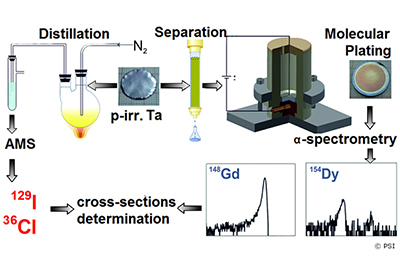
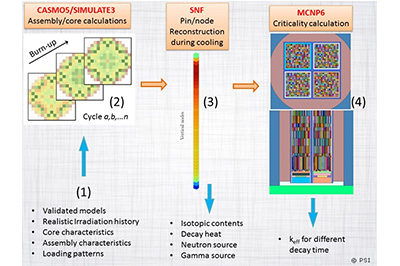
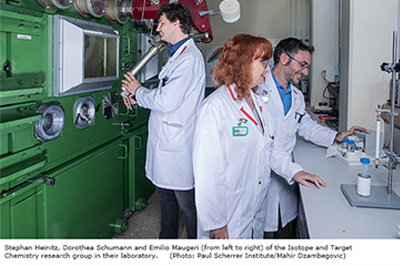
 Shortly after the Big Bang, radioactive atoms of the type beryllium-7, among others, came into being. Today, throughout the universe, they have long since decayed and do not occur naturally, in contrast to their decay product lithium. Now researchers at the Paul Scherrer Institute PSI have helped to better understand the first minutes of the universe: They collected artificially produced beryllium-7 and made it into a sample that could be investigated. The beryllium-7 was subsequently probed by researchers at CERN. The joint study by PSI, CERN, and 41 other research institutions addresses the so-called cosmological lithium problem: There is a marked discrepancy between the amount of lithium the Big Bang theory predicts should be in the universe and the amount of lithium actually observed. According to the present study, it now appears more likely that the cause of this cosmological lithium problem lies in the theoretical description of the origin of the universe. The scientific community will thus have to keep searching for a solution to the cosmological lithium problem. The researchers now published their results in the journal Physical Review Letters. (далее…)

 Корпорация «Uranium Corporation India Limited» (UCIL) будет разрабатывать крупнейшее в Индии месторождение урана, что потребует инвестирования около 845 млн долл. США. Корпорация прогнозирует добычу 6000 т/сутки.