Рубрика: ETSON

Bel V участвует в подготовке к демонтажу энергоблока «Тианж-2»

Согласно закону о поэтапном отказе от ядерной энергетики в Бельгии, энергоблок № 2 АЭС «Тианж» был окончательно остановлен в январе 2023 г. после 40 лет эксплуатации. «Тианж-2» вошел в так называемую постэксплуатационную фазу, в течение которой лицензиат готовит его безопасный демонтаж, в частности осуществляет полную химическую системную дезактивацию (FSD). Подготовка FSD была сложной задачей и осуществлялась при содействии Bel V. Задача была выполнена успешно, а опыт ее реализации будет использован для подготовки энергоблоков других АЭС к демонтажу.

Ссылка на новость

Теги: ETSON

RATEN ICN координирует проект ECOSENS

Проект «Экономические и социальные аспекты будущего ядерной энергетики в обществе» (ECOSENS), координируемый RATEN ICN, направлен на создание нейтрального пространства, где специалисты по исследованиям и политике в области ядерной энергетики, а также по социальным наукам (включая экономику, социологию, исследования науки и технологий) и гуманитарным наукам будут встречаться, обмениваться мнениями и сотрудничать с гражданским обществом и другими заинтересованными сторонами.

ECOSENS является частью глобальной инициативы Евросоюза по сокращению выбросов углерода, повышению энергетической безопасности и содействию устойчивости.

Ссылка на новость

Теги: ETSON

Оказание международной поддержки органу регулирования Турции

С 2022 г. SURO (организация научно-технической поддержки чешского регулятора) координирует так называемый Компонент D проекта «Культура ядерной безопасности-2022» под названием «Дальнейшее укрепление регулятора ядерной безопасности и радиационной защиты Турции». Цель данного проекта, следующая из названия, достигается путем оказания SURO поддержки NDK (Орган регулирования ядерной безопасности Турции) во множестве областей, касающихся ядерной и радиационной безопасности.

Поддержка турецкого регулятора осуществляется в рамках более глобальной инициативы Европейской комиссии под названием «Европейский инструмент международного сотрудничества в области ядерной безопасности» (INSC). Членами данной инициативы также являются Словенское управление по ядерной безопасности, Управление по ядерному регулированию Словацкой Республики и Венгерское управление по атомной энергии.

Ссылка на новость

Теги: ETSON

На пути к оптимизации систем инженерных барьеров приповерхностных объектов захоронения отходов

Проект «Оптимизация приповерхностного захоронения на основе знаний и понимания» является одним из рабочих проектов, софинансируемых Европейским союзом в рамках Европейского партнерства по управлению радиоактивными отходами (EURAD). Под руководством румынского RATEN ICN проект объединяет специалистов из 29 европейских учреждений для совместного проведения лабораторных экспериментов и испытаний на площадках в сочетании с моделируемыми исследованиями с целью углубления текущего понимания поведения и характеристик многослойных покрытий и цементных барьеров приповерхностных объектов захоронения. Работа в рамках проекта ведется с 1 октября 2024 г.

Сочетание испытаний на площадках и лабораторных исследований с использованием современных числовых моделей обеспечит необходимую надежность результатов и облегчит разработку рекомендаций по оптимальной конструкции систем инженерных барьеров с точки зрения безопасности.

Ссылка на новость

Теги: ETSON

Форум по культуре безопасности в Японии

Агентство по ядерной энергии Организации экономического сотрудничества и развития (АЯЭ ОЭСР) и Всемирная ассоциация операторов атомных электростанций (ВАО АЭС) в 2018 г. запустили форумы по культуре безопасности (CSSCF) для изучения примеров культуры безопасности, характерных для конкретных стран. CSSCF проводились в Швеции (2018 г.), Финляндии (2019 г.) и Канаде (2023 г.), по их итогам были опубликованы отчеты, обобщающие национальные культурные особенности и влияние на культуру безопасности. Япония стала четвертой страной, принявшей CSSCF 14–15 декабря 2023 г. Презентация отчетов состоялась в июле 2024 г., после чего наступил период анализа результатов форума 2023 г.

В целом, участники свободно обсуждали в каждой рабочей группе и в общих дебатах вопросы по повестке дня, концентрируясь на рассмотрении опыта друг друга, не ограничиваясь положением или организационным статусом. Диалог без обмена визитными карточками и в неформальной обстановке был особенно эффективным в качестве примера продвижения психологически безопасной среды в рамках обсуждения вопросов культуры безопасности, что и подтвердило проведения форума в таком формате.

Ссылка на новость

Теги: ETSON

Укрепление организационных возможностей для будущих исследований радиационной защиты

Поскольку ядерные технологии постоянно развиваются, играют важную роль во многих секторах деятельности человека, принося существенные выгоды и поддерживая прогресс в науке, промышленности или здравоохранении, вопрос защиты людей и окружающей среды становится все более важным.

RATEN ICN – Институт ядерных исследований Питешти (Румыния) – создал и поддерживает силами Лаборатории радиационной защиты, защиты окружающей среды и гражданской обороны (LRPMPC) Программу радиационной защиты, которая включает в себя комплекс эффективных мер радиационной защиты:

  • контроль жидких сбросов и газообразных выбросов от ядерных установок;
  • мониторинг радиоактивности окружающей среды;
  • радиационный контроль на рабочем месте;
  • мониторинг доз, полученных персоналом.

Недавно инфраструктура LRPMPC RATEN ICN была модернизирована, и теперь лабораторные помещения оборудованы системами, которые позволяют персоналу выполнять свою деятельность по данной программе в оптимальных условиях.

Ссылка на новость

Теги: ETSON

Development of the Software for Evaluation of Emergency Response Exercises at the Rostechnadzor Information and Analytical Centre

Guidelines for evaluating effectiveness of emergency drills and exercises (IAEA EPR-2005) © IAEA © SEC NRS

Guidelines for evaluating effectiveness of emergency drills and exercises (IAEA EPR-2005) © IAEA © SEC NRS

The Exercise Evaluation software was developed by the SEC NRS to render the scientific and technical support to the Information and Analytical Centre of Rostechnadzor (Rostechnadzor IAC) — the Russian state safety regulation authority in the field of atomic energy.

The software is meant to be used by the Rostechnadzor and SEC NRS staff – members of the Rostechnadzor IAC working groups – to evaluate the preparedness and actions of the NPP operators in emergency drills and exercises. The software implements the recommendations of the ‘Guidelines for Evaluating the Effectiveness of Emergency Response Drills and Exercises Conducted by Nuclear Power Plant Operator’, approved by the Rostechnadzor Order No. 525 of November 7, 2013 (‘the Guidelines’). The criterion component of these Guidelines rests upon the requirements of relevant federal nuclear safety rules and regulations (‘Regulation on the Procedure for Declaring an Emergency, Prompt Reporting and Arrangement of Emergency Assistance to Nuclear Power Plants in Case of Hazardous Radiological Situations’ (NP-005-16), etc.). The final judgement philosophy implemented in the software is based on the recommendations given in the IAEA document Exercise 2005 “Preparation, Conduct and Evaluation of Exercises to Test Preparedness for a Nuclear or Radiological Emergency” (EPR-2005), and enables a quantified assessment of exercise / drill effectiveness.

The Exercise Evaluation software provides for emergency exercise / drill evaluation in 15 key emergency preparedness areas, including the completeness and correctness of operational information, the correctness of radiological consequences assessment for the accident, the size of protective measures, level according to the International Nuclear Event Scale (INES), timely notification of emergency response participants, and actions to evacuate personnel not involved in the accident management activities.

The introduction of the Exercise Evaluation software has brought a number of significant benefits for the Rostechnadzor IAC:

  • minimized risk of incorrect INES classification of human performance events;
    easier application of the Guidelines;
  • lower labour and time input to make the evaluation;
  • automatic generation of a report containing the final judgement on exercise / drill effectiveness.

The software also features flexible display, storage and structuring of information on the results of emergency drills and exercises conducted by the NPP operators. Furthermore, the data base on exercise / drill results integrated into the software, allows comparing the nuclear plants in terms of diligent fulfilment of the requirements of federal nuclear safety rules and regulations while contributing to regulatory decision-making by Rostechnadzor.

Contact: Denis Mistryugov, SEC NRS, mistryugov@secnrs.ru
Source: ETSON

Development of Safety Regulation Approaches for Land-Based Small Power Nuclear Plants with Small Modular Reactors in the Russian Federation

The floating nuclear power unit ‘Akademik Lomonosov’ © OKBM Afrikantov

The floating nuclear power unit ‘Akademik Lomonosov’ © OKBM Afrikantov

In recent years, there has been a growing interest across the world in the designs of small nuclear power plants (SNPP) with small reactors of various types. The Russian Federation has amassed ample experience in regulating the safety of marine nuclear power installations, in particular, in the course of the oversight and supervision over icebreakers operation.

The regulatory legal framework for regulating the safety of vessels and other watercraft with nuclear reactors, developed relying on this experience, takes into consideration the recommendations of the IAEA and IMO, the provisions of relevant international conventions and the requirements of national shipping regulations, and was used as a groundwork to put in operation the world’s first floating nuclear unit ‘Akademik Lomonosov’ which is in essence a floating nuclear power plant. However, the regulatory legal framework used for the floating SNPP is not applicable to the land-based small nuclear power plants because of a great number of requirements specific to stationary nuclear facilities.

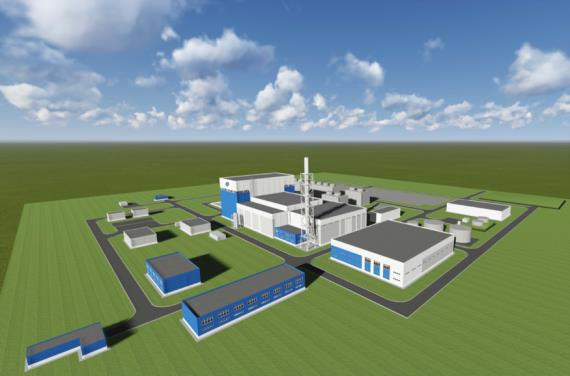
Currently, the most promising Russian design of a land-based small nuclear power plant is that of a plant with the RITM-200 reactor system. The design is to be implemented in the framework of the comprehensive national programme ‘Development of Equipment, Technologies and Scientific Research in the Field of Atomic Energy in the Russian Federation for the Period up to 2024’ endorsed by the Russian President decree No. 270 of 16.04.2020.

General view of the SNPP with RITM-200 reactor © OKBM Afrikantov

General view of the SNPP with RITM-200 reactor © OKBM Afrikantov

The RITM-200 reactor plant has a unique integral configuration so that the core and the primary circuit components are placed directly inside the steam generation unit. The steam generation unit is quite compact and is fully assembled at factory, which ensures high-quality assembly and simplifies the unit transportation to the SNPP site.

Being a scientific and technical support organisation for Rostechnadzor, starting with 2019, SEC NRS has been providing a pre-licensing tracking of the land-based SNPP designs, including the RITM-200 facility. Thus, it looked at the safety philosophy of the land-based SNPP with the RITM-200 reactor, and made a preliminary assessment of the compliance of RITM-200 design solutions with the requirements of relevant nuclear regulations. The key objective of the study was to assess the adequacy of the existing regulatory requirements for regulation of nuclear, radiological and industrial safety of SNPP with RITM-200 reactor facility. The analysis has confirmed that the documents regulating the safety of large NPPs are suitable for regulating the RITM-200 SNPP safety. The analysis also identified the RITM-200 SNPP design features that may require amendments in the current federal nuclear safety rules and regulations and the improvement of relevant standards. At the same time, the designers were advised of the areas requiring further demonstration of the RITM-200 SNPP safety or changes in the design documentation.

Contact: Denis Mistryugov, SEC NRS, mistryugov@secnrs.ru
Source: ETSON

Coronavirus Pandemic Challenges Identified by Rostechnadzor and Actions Taken to Address Them

Similar to the situation with other human activities, the coronavirus pandemic has put to test the regulator ability to adapt and retain effective performance under extreme conditions. The emergency procedures are normally developed to respond to human-induced disasters, and to the nuclear facility accidents initiated by natural or human-made events. In the face of the coronavirus, these procedures require a scrupulous adjustment to accommodate the new challenges posed by the pandemic.

The Regulator is challenged primarily to:

  • protect the life and health of its own staff (both in headquarters and regional offices), and the staff of the operating organisations ensuring safe operation of the nuclear facilities under the coronavirus pandemic;
  • arrange effective remote work, including conduct of remote inspections to ensure continued oversight of the nuclear and radiological safety at supervised facilities.

Rostechnadzor developed and has been implementing the following measures to meet these challenges:

  • the number of the Rostechnadzor on-the-job staff has been reduced to as low as practical. All these people have been provided with personal protection items, their social distancing has been secured, and they have been regularly tested for coronavirus;
  • remote work has been arranged for the rest of the Rostechnadzor staff through state-of-the-art digital communication tools, to ensure timely receipt of necessary information and provide access to data bases as needed for their efficient work.

Apart from that, the regional offices of Rostechnadzor were instructed to:

  • ensure appropriate scope of inspections and other activities to enable verification of the nuclear plant safety by the inspectors authorized to perform continuous state supervision;
  • introduce supervision over the implementation of the additional measures developed by Rosenergoatom to ensure the safe operation of the nuclear power plants under the high alert regime imposed on the territory of the Russian Federation.

Also, the Rostechnadzor guided the operating organisations to:

  • ensure safe operation of the nuclear power plants under current restrictions;
  • develop additional actions to ensure the operational safety of the nuclear power plants, in particular:
    • increase the number and thoroughness of the process system / equipment rounds;
      deliver extra briefings for personnel to underline the work specifics under the high alert regime;
    • minimise scheduled lineups and maintenance of equipment, except for emergencies;
      ensure the safety of the operating and duty personnel at the nuclear power plants in compliance with relevant public health requirements;
    • develop measures to warrant availability of at least the minimum number of operating personnel justified in the design documentation, should part of the staff be taken to hospitals.

Contact: Denis Mistryugov, SEC NRS, mistryugov@secnrs.ru

Source: ETSON

Thermal Fatigue issue in the Upper Plenum Injection lines at Doel 1-2

Figure 1 (© Engie)

Figure 1 (© Engie)

A leak suspected to have been caused by high cycle thermal fatigue due to fluctuating axial motion of a swirl penetration front end has been detected in early 2018 in a non-isolable Reactor Coolant System branch at the Doel 1 Nuclear Power Plant (Belgium).

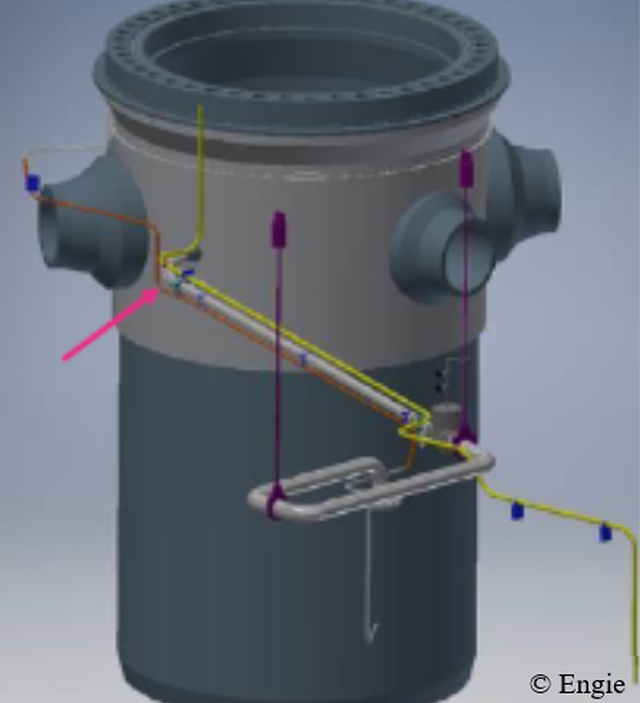
As a part of the standard design of the Westinghouse 2-loop PWRs, the Doel 1 and Doel 2 units are equipped with ECC systems that inject water into the upper plenum of the reactor pressure vessel in the event of a LOCA, as opposed to the cold-leg injection that is also present. Each of both reactors has two 4-inch UPI lines made of Type 316 stainless steel and further referred to as UPI-A and UPI-B lines. Figure 1 illustrates the layout of the UPI-A lines. When compared to the UPI-A lines, the UPI-B lines are shorter and have a slightly different slope.

The UPI injection ports are at the same elevation as the RPV inlet and outlet nozzles. In the initial design of the Doel 1 and Doel 2 units, the UPI lines provided ECC water in the lower plenum by injection in the downcomer but in 1992 ther injection ports were re-configured to the UPI design by plugging the opening towards the downcomer and drilling a hole into the core barrel. Figures 2 and 3 illustrate the design of the injection ports in both configurations.

On the 23rd of April 2018, a primary leak was detected at Doel 1 while the unit was in full power operation. Consequently, the unit was brought to cold shutdown conditions. The leak was found to be located on the UPI-A line inside the reactor cavity in the pipe section downstream of the check valve, i.e., in a non-isolable RCS branch. Extensive NDE of the damaged UPI-A line including mechanized VT, ET, UT, and UT-TOFD from the inside of the pipe has evidenced several cracklike indications in the bottom part of the straight part of the pipe upstream of the weld between the straight section and the elbow close to the leak location, as well as a circumferential indication in a neighboring weld. As a result of those findings, the same NDE was performed on the UPI-B line of Doel 1 and on both UPI lines of Doel 2. These inspections highlighted similar degradation on the UPI-A line of Doel 2 at the same location. By contrast, no reportable degradation was observed on the UPI-B lines.

The affected section the UPI-A lines was removed for further laboratory investigations aiming at investigating the possible mechanisms responsible for the formation of the cracks. The outcomes of the investigations allowed the plant Licensee (Engie) to conclude that the mechanism responsible of the cracking phenomenon was fatigue. More specifically, different features heavily suggested that the mechanism is a low stress, high-cycle fatigue mechanism, possibly environmentally (primary water) assisted. Root cause analysis performed by the Licensee concluded that this phenomenon would have likely been related to the occurrence of cyclic thermal stresses in the wall thickness of the piping. A detailed understanding of how the damage could develop, implying in particular a quantitative description of all involved phenomena, could however not be provided.
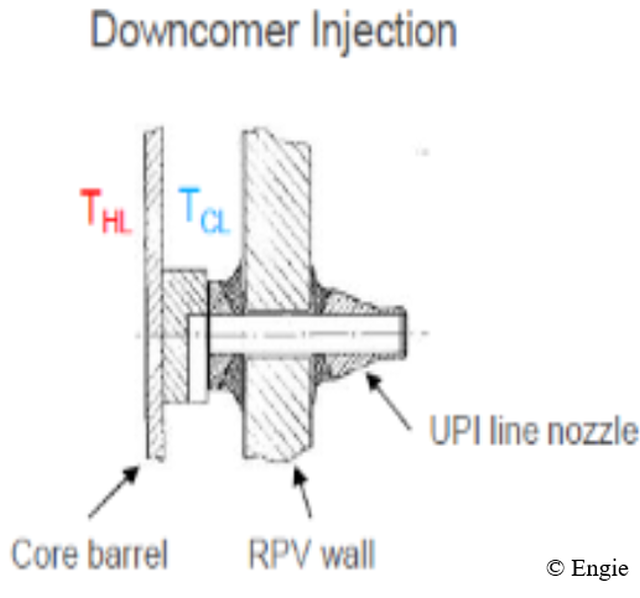
Figure 2 (© Engie)

Figure 2 (© Engie)

The removed sections of the UPI-A lines were replaced and a specific Safety Case has been provided by the Licensee for each unit, as a justification for their restart. Despite an incomplete understanding of the degradation phenomenon, the Licensee justified the allowance for restart on the basis of different actions among which of the replacement of the damaged UPI-lines, the planning of NDE at regular intervals as well the continuous monitoring of those lines and in particular the temperature monitoring of the external wall temperature at specific locations by means of the FAMOSi Data acquisition system. In answer to Bel V’s concern, the Safety Cases were based on the application of the Defence in Depth principle, by showing how the actions defined in the Safety Cases are related to the first three Levels. After evaluation, Bel V concluded that the Doel 1 and Doel 2 plant might be operated safely during a time period of one fuel cycle, which is expected to be the time necessary to identify and quantify the thermal cyclic loadings suspected to be the mechanism responsible for the detected cracking. Authorization for restart was granted by the Belgian Federal Agency for Nuclear Control and both plants resumed operation early in 2019.
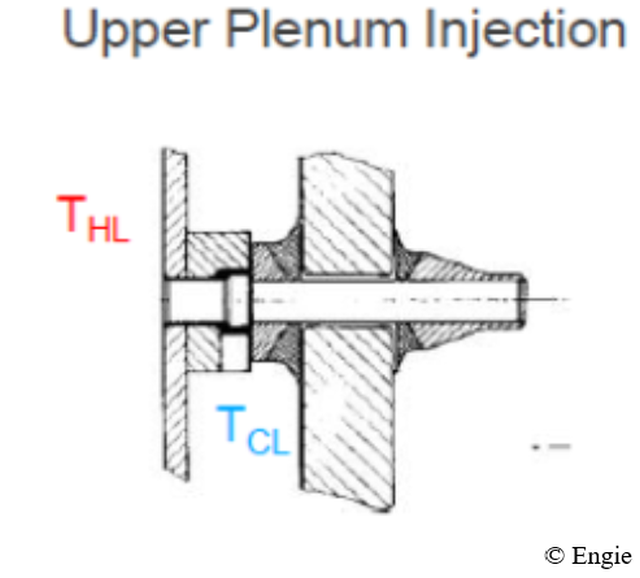
Figure 3 (© Engie)

Figure 3 (© Engie)

During the 2019 fuel cycle, two major achievements should be highlighted. First, the temperature measurements recorded by the FAMOSi system during four different plant conditions, i.e. cold shutdown, heat-up, hot stand-by, power ramp-up and full power were made available and analyzed by the Licensee by means of a homemade computer code allowing to estimate the temperature evolution of the fluid inside the pipe from the recorded temperatures. Although the FAMOSi system has experienced reliability issues, some conclusions were able to be drawn from the temperature records. Temperature fluctuations were observed on all UPI lines as soon as at least one reactor coolant pump is running, whatever the plant condition. However, those temperature fluctuations are not significant , which led the Licensee to conclude that the thermal cycling which was suspected to be at the origin of the observed cracks is rather a consequence of cycling flow structures inside the lines. Secondly, the results of Computational Fluid Dynamics (CFD) calculations performed by the Licensee have been issued. Those calculations point out that cycling flow structures could develop in UPI-A lines in the presence of a gap between the reactor vessel UPI nozzle and the core barrel. The presence of this gap, which has been confirmed during the visual examinations carried out on the inside of the UPI lines, is a side effect of the reconfiguration from downcomer injection to upper plenum injection. The pressure difference existing between the downcomer and the upper plenum generates a flow through the gap, which then induces a swirling structure extending in the UPI-A line up to the degraded region if adequate non-symmetric flow ingress through the gap is assumed. Beyond that swirl penetration zone, a natural circulation loop with stratification is present. Between those thermal fields, a transition zone occurs with potentially high temperature difference. The CFD calculations also confirm that, if slightly varying gap boundary conditions are assumed, the extension of the swirl region moves back and forth, which induces large temperature fluctuations in the degraded region. With regard do that, it should also be pointed out that the assumed mechanism also explains why the UPI-B line is not or less affected than the UPI-A line. The better thermal insulation on this former line indeed induces a smaller thermal axial gradient along the line, especially in the natural circulation loop zone. This explains why smaller thermal fluctuations will occur when the extension of the swirl zone moves back and forth.

However, convincing experimental demonstration could not be achieved due to lack of temperature measurement sections at some critical locations but also to a lesser extent, due to the reliability issues encountered by the FAMOSi system. In order to hopefully conclude about the identification of the mechanism responsible for the damage phenomenon and the explanation of the occurrence of the damage phenomenon under the assumed mechanism, the Licensee decided to remedy the malfunctions of the FAMOSi system and to install additional measurement sections during the next refuelling outage of the units.

During the 2019-2020 outage, several non-destructive inspections have been carried out on the UPI lines of Doel 1 and Doel 2, according to the programme agreed with the Safety Authorities. Depending on the part of the line, VT, UT, LP and/or RX techniques have been used. No reportable indication has been detected.

In March 2020 an Addendum Safety File was issued by the Licensee, which summarizes the results from the most recent investigations, reassesses the Root Cause Analysis and justifies the safe operation of both plants Doel 1 and Doel 2. The request of the Licensee to allow the restart of the Doel 1 and Doel 2 unit was accepted by the Federal Agency for Nuclear Control, with due consideration of the Addendum Safety File and the inservice inspection program of the UPI lines.

A first assessment of the temperature monitoring results is expected by the end of September 2020.

Contact: Guy Roussel, Bel V, guy.roussel@belv.be

Russia has Developed Guidance on Estimation of Errors and Uncertainties in Computational Safety Analyses

Russian federal nuclear safety rules and regulations ‘Basic Safety Provisions for Nuclear Power Plants’ (NP-001-15) establish a requirement to complement the safety analysis for a nuclear power plant with estimation of errors and uncertainties in the obtained results. Similar requirements can be found in regulatory documents of nuclear safety authorities in most of the countries with well-developed nuclear programme, as well as in the IAEA document GSR Part 4 ‘Safety Assessment for Facilities and Activities’.

Over the past three decades, the Russian Federation, the same as many other countries, has accumulated a great deal of experience in the application of uncertainty estimation techniques for the results of the calculations performed to demonstrate various aspects of the nuclear plant safety. However, these methods are usually discussed in scientific papers published in journals, or in presentations made at conferences, seminars and meetings, while their actual application in respect of NPP safety documentation is very limited, despite the above requirements enshrined in the nuclear safety authority regulations. This may be caused by the lack of national regulatory documents that would guide the safety documentation authors on how they should fulfil the requirement to estimate errors and uncertainties in the results of computational safety analyses.

With this in mind, the SEC NRS had developed a Nuclear Safety Guide ‘Guidance on Estimation of Errors and Uncertainties in the Safety Analysis for Nuclear Power Plants’ (RB-166-20) that was approved by the Federal Environmental, Industrial and Nuclear Supervision Service in its the order No. 288 of July 30, 2020.

The RB-166-20 Safety Guide contains the recommendations on estimation of errors and uncertainties in the results of a deterministic safety analysis performed using the software tools to demonstrate safety of a nuclear power plant. Thus, the Federal Environmental, Industrial and Nuclear Supervision Service has become a pioneer in issuing uncertainty estimation recommendations.

Before starting the RB-166-20 development, the authors made an overview of the world’s best practices in the assessment of errors and uncertainties in the results of the computational safety analyses for nuclear power plants. The study was carried out by SEC NRS together with the staff of the Institute for Safe Development of Nuclear Power with Russian Academy of Sciences, the National Nuclear Research University ‘MIFI’, and the A.P. Aleksandrov Science and Research Technological Institute which is part of the State Atomic Energy Corporation ‘Rosatom’. Noteworthy is the significant contribution made in the RB-166-20 drafting by the staff of the OKB GIDROPRESS, NIKIET, Afrikantov OKBM, Research Centre ‘Kurchatov Institute’, and VNIIAES.

The RB-166-20 consists of two main sections. The first section provides guidance on accounting for uncertainties in the design safety analysis for a nuclear power plant. The second section gives recommendations for the use of uncertainty evaluation methods. The Annexes to the RB-166-20 contain a block diagram showing the uncertainty estimation process for the results of the computational analysis of the design-basis accidents at a nuclear power plant, and a description of the approach to the assessment of errors and uncertainties in the results of beyond-design-basis accident calculations for nuclear power plants, including severe accidents.

The Safety Guide is meant to be used by the staff of operating organisations, Rostechnadzor divisions, and other institutions conducting activities in the field of nuclear energy.

Contact: Denis Mistryugov, SEC NRS, mistryugov@secnrs.ru