Рубрика: Интервью

Cladding tubes and their properties
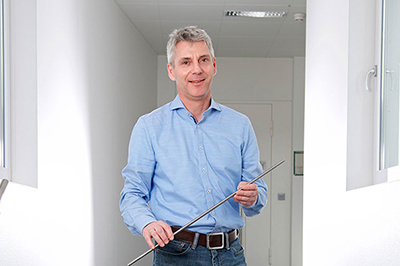
One of the broad research areas at PSI covers the topic of energy. Part of that, in turn, is the research for nuclear energy and safety. And one of the research groups based here is engaged with nuclear fuels. Johannes Bertsch is the head of this group and investigates the importance of so-called cladding tubes and their protective layers.

Johannes Bertsch could probably sketch the construction of a nuclear power plant blindfolded, especially when it comes to the core of the plant: How many fuel rods, made of what materials, are arranged in how many bundles. He has the numbers, dimensions, and facts in his head. He is the head of the Research Group for Nuclear Fuels at PSI, and his area of expertise are the sheaths of the fuel rods: the so-called cladding tubes.

The cladding tubes enclose the energy source of the power plant, the fissile uranium. In other words: The uranium is pressed into tablet-shaped ceramic pellets which are then stacked inside the cladding tubes. Typically four metres long, the cladding tubes have a diameter of one centimetre and a wall thickness of only 0.6 millimetres – so these are very long tubes, about as big around as a finger, with thin walls made of a special alloy. In the core of a nuclear power plant, there are typically several tens of thousands of them.

The cladding tubes are designed to withstand high temperatures and pressure during operation; they should not develop any cracks even after the removal of the spent fuel rods from the reactor, and they should survive transport undamaged – first to an interim storage facility and later to permanent storage. Therefore the cladding tubes aren’t made from just any sheet metal, but rather from a very finely balanced metal alloy: to 98% zirconium are added well thought-out amounts of chromium, iron, nickel, niobium, and tin. This special alloy is manufactured using a process just as special: melted, cooled in a controlled way, drawn, hammered and annealed. The result is a metal that, viewed microscopically, consists of tiny crystalline grains whose size is just as optimised as their internal crystalline orientation. There are decades of research and optimisation behind that, Bertsch says.

Today this optimisation process is mainly focused on one concern: Hydrogen should penetrate as little as possible into the metal of the cladding tubes, because there the hydrogen forms bonds with the metal atoms that could weaken the material of the cladding tubes.

The hydrogen itself comes from the water that – at least in the Swiss nuclear power plants – is essential. During operation, water continuously surrounds the fuel rods, cools them, and removes the heat arising from the fission of the atomic nuclei. This creates steam that drives the large turbines by which, ultimately, the nuclear power plant produces electricity.

So there’s no way to avoid the hydrogen. But what happens when the small atoms of hydrogen wangle their way into the atomic lattice of the metal alloy?

“Like sugar in coffee”

“First, the hydrogen is dissolved in it”, Bertsch says. Although these are single atoms in a solid material, the researchers talk about it as a solution. “It is actually like sugar in coffee”, Bertsch continues. And from the coffee, you know: If it’s too much sugar, or if the coffee is too cold, the sugar does not dissolve any more, and it accumulates on the bottom of the cup.

Here the analogy ends; there is no bottom of the cup. What actually happens: The hydrogen no longer moves freely through the material, but instead chemically bonds with the metal atoms to form a hydrogen-metal compound. A hydride, as the researchers call it.

The problem with these hydrides: “They form elongated, platelet-like, criss-crossing structures in the metal of the cladding tube. And these are weak points in the material.”

Imaging with neutrons makes hydrogen visible

The PSI researchers who work with Johannes Bertsch concern themselves with everything related to these hydrides. How do they alter the stability of the material? How can they be minimised? How can it be ensured that all cladding tubes stay intact at all times? “We are expanding the knowledge that exists in this context”, Bertsch says.

To do that, he and his colleagues rely on a method of imaging by means of neutrons. Neutron imaging, as it is called, is a method that was perfected at PSI and is regularly carried out by one of PSI’s own research groups at the local neutron source SINQ, with one of the world’s best neutron microscopes. With it, the most diverse types of objects can be examined.

Zirconium is virtually transparent for neutrons. That accounts for its use as the main component of the cladding tubes, since in the operation of a nuclear power plant, free neutrons are a desirable product. In addition, this proves to be an advantage in neutron imaging, because unlike zirconium, hydrogen reveals itself in neutron images as a dark contrast.

Protective layer may also help against hydrides

In one of their newest research projects, Bertsch’s research group is studying the additional protective layer on cladding tubes: So-called liners are used worldwide, and particularly in Switzerland. They protect the cladding tubes against mechanical damage and against oxidation.

Liners, Bertsch and his colleagues found, have a positive side-effect in eliminating hydrides: Cladding tubes equipped with such a protective layer exhibit less hydrides underneath. “The hydrogen penetrates more and more into this layer and already gets stopped there”, says Bertsch, summarising the research results. “You can say the liner is like a sponge for the hydrogen.” It’s as if a person in a bathrobe were to walk in drizzling rain: The terry cloth soaks up the water, and the skin stays dry.

Since it is already clear that hydrides weaken the cladding tubes mechanically, the researchers now venture the cautious statement that the liners, which were introduced originally for other reasons, probably make the cladding more stable in the long run.

“Ultimately, it’s our job to better understand how to make the operation and the handling of spent fuel rods even safer”, Bertsch says. “To do that, we investigate the details of the material’s internal structure. How the hydrides arise, how they are distributed, how they weaken the material – and above all, how they can be minimised.”

International interest

The comprehensive research on hydrides that Bertsch and his team are engaged with is first and foremost aimed at ensuring the safety of the nuclear facilities in Switzerland. But their work also meets with great interest internationally. “We get inquiries from Germany, where the reactors are now being shut down, and we have already been invited to the USA”, Bertsch relates. “Hydrides in cladding tubes are actually a hot topic in the research world.”

Источник: eurosafe-forum, November 2019
Теги: Bertsch, PSI

«Росатом» не попал под регуляторную гильотину

Атомной отрасли не коснется объявленная правительством России отмена устаревших и избыточных нормативов — так называемая регуляторная гильотина. Почему принято это решение, как продвигается лицензирование новых реакторных технологий и нужно ли предъявлять к малым АЭС такие же строгие требования по безопасности, как к большим, рассказывает Рашет Шарафутдинов, заместитель директора Научно-технического центра по ядерной и радиационной безопасности (НТЦ ЯРБ, организация научно-технической поддержки Ростехнадзора).

— На XIV Международном ядерном форуме «Безопасность ядерных технологий: культура безопасности» вы сообщили, что регуляторная гильотина не коснется атомной отрасли. Почему?

— Отменять или кардинально изменять существующую систему требований по безопасности в области использования атомной энергии чрезвычайно опасно. В ней накоплен опыт еще с 1950-х годов. Если заново формулировать требования к безопасности объектов использования атомной энергии, можно многое упустить. Чтобы избежать снижения требований по безопасности к атомным объектам, правительство России приняло решение вывести нормативную базу по безопасности атомной промышленности из-под регуляторной гильотины.

— Предприятия «Росатома» разрабатывают наземные АЭС с модульными реакторами малой мощности РИТМ‑200 и быстрый реактор большой мощности БН‑1200. Лицензирование этих технологий уже началось?

— Что касается атомных станций малой мощности (АСММ) с РИТМ‑200, сейчас в НТЦ ЯРБ проводят анализ технических решений по безопасности, принимаемых разработчиком (ОКБМ им. Африкантова. — «СР»), на предмет соответствия требованиям. Сама процедура лицензирования начнется только после того, как в Ростехнадзор официально направят комплект документов, обосновывающих безопасность. По реактору БН‑1200 к нам документы пока не поступали.

— В мировой атомной отрасли сейчас обсуждают возможность смягчения требований к новым реакторным технологиям, особенно к реакторам малой мощности. Что вы думаете по этому поводу?

— Вопросы нормативного регулирования безопасности реакторных установок малой и средней мощности обсуждают как за рубежом, так и в России. Ростехнадзор участвует во многих мероприятиях МАГАТЭ по этой тематике, в том числе в Форуме органов регулирования по вопросам безопасности малых модульных реакторов. Кроме того, НТЦ ЯРБ проводит самостоятельные исследования. Я считаю, людям, живущим рядом с АЭС, все равно — малый реактор у них под боком или большой. В любом случае безопасность должна быть обеспечена. Есть целый ряд вопросов по безопасности АСММ, требующих решения, — ​применение концепции глубокоэшелонированной защиты, планирование зон защитных мероприятий в случае аварии, физическая защита, ремонтопригодность, обращение с радиоактивными отходами и др. Можно было бы применить к таким реакторам нормативную базу для исследовательских ядерных установок, как это сделали, например, в Канаде. Но разработчики АСММ с РИТМ‑200 решили принять за основу нормативную базу по безопасности атомных станций. Такой позиции придерживаются и участники упомянутого форума регулирующих органов.

— То есть к АЭС малой мощности будут применяться те же требования, что и к обычной АЭС. Вы считаете смягчение нормативных требований к АСММ невозможным?

— Смягчения требований не предполагается. Требования могут быть только дифференцированы, например, по уровню мощности реактора. Мы сейчас анализируем этот вопрос. Смотрим, что можно поменять, что нового внести в нормативную базу по АЭС. Есть еще вариант — разработать новые документы, а не корректировать существующую нормативную базу. Но пока мы находимся в самом начале пути. Рассматриваем все возможные варианты.

— В отрасли есть неофициальное мнение, что российская нормативная база регулирования безопасности объектов использования атомной энергии чрезмерно разрослась. А вы как считаете?

— Этот вопрос неоднократно поднимали специалисты «Росатома». Мы выполнили анализ нормативной базы целого ряда стран, стандартов безопасности МАГАТЭ и Агентства по ядерной энергии ОЭСР, проанализировали нормативную базу Франции, США и других стран и пришли к выводу, что Ростехнадзор находится в тренде. Концепция совершенствования нормативного правового регулирования и стандартизации в области использования атомной энергии и план ее реализации предусматривают, что к 2023 году должно быть всего 116 актуализированных и вновь разработанных норм и правил. В настоящее время вопрос о количестве норм и правил не обсуждается.

— Могут ли разрабатываться нормы и правила по безопасности, если аналогичных документов не разработано в МАГАТЭ?

— Да. Дело в том, что в России есть уникальные объекты использования атомной энергии, которых нет в других странах. Например, судовые ядерные установки, суда атомного технологического обслуживания, плавучая АЭС. Для таких объектов МАГАТЭ еще не разработало свои документы, а в России действуют соответствующие нормы и правила. Кроме того, разработан проект реакторной установки БРЕСТ-ОД‑300 со свинцовым теплоносителем. Мы взаимодействуем с конструкторами этой реакторной установки при разработке двух проектов федеральных норм и правил, регламентирующих требования по безопасности к этой установке. Таких документов в МАГАТЭ тоже еще нет.

— Как идет экспертиза безопасности реакторной установки БРЕСТ-ОД‑300?

— Результаты экспертизы безопасности этой реакторной установки рассматривали на профильной секции НТС Ростехнадзора. Сейчас Ростехнадзор в очередной раз получил дополнительные материалы, обосновывающие безопасность. Генеральный конструктор (НИКИЭТ. — «СР») дорабатывает документацию, так как по ней имеются серьезные вопросы и замечания. Разработчик выполнил большую работу, но пока у органа регулирования безопасности нет оснований для принятия решения, так как экспертиза безопасности не завершена.

Кроме того, одним из основных критериев для экспертизы безопасности этой установки должен быть свод норм и правил, а таковых в необходимом объеме нет. Разработчик установки дважды представлял проекты нормативных документов на рабочую комиссию Ростехнадзора, где решается, готовы ли проекты документов к открытой публикации и общественному обсуждению. Однако до сих пор комиссия не приняла такого решения, поскольку представленные проекты документов требуют доработки.


Источник: Страна РОСАТОМ, 11.11.2019

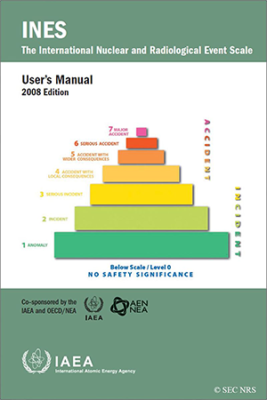
“INES Classifier” Computer Program Developed by SEC NRS Submitted to NEA Databank

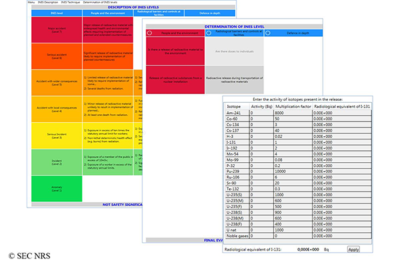
The “INES Classifier” computer program was developed by SEC NRS for scientific and technical support of the Information and Analytical Center of the Russian Regulatory Authority (Rostechnadzor).

The computer program is based on the methodology outlined in the Guidelines for users of the International Nuclear and Radiological Events Scale – INES (2008 edition) co-developed by NEA and IAEA. The INES is used for prompt and simple communication with the public on events associated with nuclear facilities in terms of their safety significance. The INES classification of events makes it possible to assess the significance level of an event that has occurred for providing instructions, warnings and relevant information to the public for emergency preparedness and response.

The “Classifier INES” computer program is designed for:

  • assessment of events significance level both in general and in terms of their effect on radiation effects, physical barriers and defense in depth levels;
  • minimization of the risk of human errors during determination of an events significance level based on INES methodology;
  • simplifying the methods for assessing the INES level;
  • reduction of human efforts and time which are required for assessments with the INES methodology;
  • automatic generation of reports that contain brief information about the criteria which were used for estimation of an events significance level based on the INES methodology.

The “INES Classifier”Computer program was successfully tested at the Rostechnadzor Information and Analytical Center during emergency response drills at nuclear power plants.

In March 2019 the “INES Classifier” computer program was submitted to the Nuclear Energy Agency Data Bank. To access the program please contact NEA Databank

http://www.oecd-nea.org/tools/abstract/detail/nea-1904/.


Contact
Andrey KIRKIN,
Scientific and Engineering Centre for Nuclear and Radiation Safety (SEC NRS)
kirkin@secnrs.ru

Источник: Eurosafe-forum.org 2019

Software used for safety review of nuclear facilities

Reliability of simulation models for nuclear installations, which are realized applying computer codes, has a vital importance for the safe use of nuclear energy. In the process of development of software that allows forecasting to the last detail of nuclear installations behavior in various operation conditions, as well as in case of an accident, the results of the advanced scientific researches are used. The most remarkable mathematicians, physicists, experimentators and software programmers take part in software development, and all components of the nuclear industry innovative development are involved. It is evident, that soundness of simulation models shall be evaluated and verified at the equally high level which is observed in the process of the software development.

Since 1991, Rostechnadzor applies in its regulatory activity the unique practice of software review, which is implemented by the SEC NRS. Since the very beginning of establishing of the software evaluation system there appeared understanding of the necessity of the open and transparent cooperation among all teams, participating in the development, verification and use of the software applied in the process of safety analysis. That is why the results of the review of such codes shall be definitely the subject to the review by the Expert Council in charge of computer codes certification under the aegis of Rostachnadzor, which includes representatives from more than 40 enterprises of the nuclear industry in Russia. The procedure for the software review was initially forethought to be a free from subjectivity team work of highly qualified specialists in the field of nuclear energy use. The solutions taken by the Expert Council are always based on the cumulative experience and knowledge of the whole scientific and technical society of the Russian nuclear industry, and represent the driving force for the development of innovative projects related to creation of new generation simulation tools and conduct of necessary experimental studies. In 2018, the more than a 25-year successful practice of computer codes review was settled by law, and the relevant amendments were introduced into the Federal Law “On the Use of Atomic Energy”.

Currently, among the most significant challenges in the context of scientific and technical aspects of computer codes development, verification and validation are as follows:

  • updating of the requirements to verification (validation) of computer codes, upgrading of the criteria and forming of approaches to evaluation of the current computer codes (including multi-physical simulation, creation of codes for CFD-DNS type PCs) and digital technologies (artificial neural networks, virtual NPPs and etc.);
  • development of recommendations on estimation of errors and uncertainties of the simulation results (preparation of the draft first revision of the relevant Guide has been planned for the year 2019);
  • the system development of the experimental base and creation of the unified digital base of the evaluated experimental data, which can be used in the process of verification (validation) of the modern computer codes in the field of use of nuclear energy;
  • evolvement of the approaches to rating of computer code users qualification.


Contact
Sergey SHEVCHENKO,
Scientific and Engineering Centre for Nuclear and Radiation Safety (SEC NRS)
sshevchenko@secnrs.ru

Источник: Eurosafe-forum.org 2019

Improving the methods for justification and assessment of long-term safety of the deep disposal facilities for liquid radioactive waste to implement the recommendations of the IAEA Mission

Deep disposal facilities for liquid radioactive waste (DDF LRW) have been operating over 50 years in the Russian Federation. The disposal of liquid radioactive waste (LRW) is carried out by controlled well injection of LWR into deep horizons, isolated from the surface by low permeable rocks and shallow aquifers.

In 2013, the IAEA Mission «International peer review on the deep well injection practice for the liquid radioactive waste in the Russian Federation» was carried out in the Russian Federation. The IAEA Mission resulted in a report containing recommendations for improving the safety in the disposal of LRW in the Russian Federation.

In 2015, the «Program of calculated and experimental studies on justification and assessment of long-term safety of the deep disposal facilities for liquid radioactive waste in order to implement the recommendations of the IAEA mission» was developed. Some parts of this program are implemented by SEC NRS together with some leading academic institutions and ROSATOM’s enterprises.

The first stages of the work focused on consolidation and systematization of information on DDF LRW locations and sites. Information on the geographical, meteorological, geological characteristics of the DDF LRW locations and sites was reviewed; well design features were described; information on the radionuclide and chemical composition of injected LRW was provided, as well as the results of uncertainty estimation of the raw data.

The obtained information was used at the following stages: to prepare the experimental programs for defining parameters necessary for modeling of the processes at the radioactive waste (RW) disposal system; to develop the DDF LRW geofiltration and geomigration three-dimensional models; to analyse events, phenomena and factors which are taken into account in scenario development for the evolution of the RW disposal system.

One way to improve the long-term safety assessment, taking into account the IAEA recommendations, was developing the DDF LRW simulation models and performing predicting calculations to assess long-term safety for RW disposal system after DDF LRW closure. For this purpose, DDF LRW models have already been developed and updated by SEC NRS and new geofiltration and geomigration models have also been developed. So, the Russian-made software tool GeRa (developed by IBRAE RAN) was used for model development. The models were supplemented with planned volumes and LRW characteristics for the period up to DDF LRW planned closure, the boundary conditions for the models were also specified, the ranges of permeability coefficients were defined for horizons and low permeability formations. The preliminary results of calculations performed for the developed scenarios of normal evolution indicated the permissible DDF LRW exposure in the long term.

Fig. Structural model of “Dimitrovgradskiy” DDF LRW built usiFigure Structural model of “Dimitrovgradskiy” DDF LRW built using software GeRang software GeRa

Another area of research within the implementation of the IAEA Mission recommendations is to justify the safety of the DDF LRW closure. To this end, the concept of the DDF LRW closure has been developed, which defines the main stages of work on the DDF LRW closure, including organizational and technical solutions for ensuring safety in and after closure, measures on radiation monitoring, volume and frequency of radiation monitoring and monitoring of the RW disposal system as well as, the procedure of collecting and storing (transmitting) information obtained at various stages of the LRW life cycle.

According to this concept, wells are eliminated using special technologies for reliable isolation of the horizon from the overlying formations, as well as excluding overflows along the annular and intertubular space of well casing strings.

To confirm the safety of the DDF LRW after closure, a set of measures on radiation monitoring of the DDF LRW site and on monitoring of the RW disposal system, as well as environmental components, should be carried out. The duration of the DDF LRW monitoring after its closure depends on the radionuclide composition and total activity of injected LRW and it is defined based on the results of the long-term safety assessment.

Currently, the final report on the implementation of the IAEA mission recommendations is being developed.


Contact
Anton PONIZOV
Scientific and Engineering Centre for Nuclear and Radiation Safety (SEC NRS)
ponizov@secnrs.ru

Источник: Eurosafe-forum.org 2019

Digital strategy of nuclear sector development

Following the already established trend of digital transformation of global world economy, nuclear industry is moving towards post-industrial development. The distinctive feature of the atomic industry transformation is the comprehensive implementation of information processes into all spheres of activity in the field of atomic energy use.
In Russia, a Digital strategy of nuclear sector development designed by the State Atomic Energy Corporation “ROSATOM” is currently being implemented. This strategy established, among other things, broad implementation of modern computer programmes for nuclear facilities simulation, digitization of key processes for development and safety review of innovative nuclear technologies, development and implementation of intelligent systems using various ways of machine learning, as well as broad implementation of digital twins into life-cycle management of nuclear facilities.

SEC NRS as a technical and scientific support organization to Rostechnadzor is committed to the principle of giving priority to the safe use of atomic energy. In this regard, it is involved in shaping an approach to justification and assessment of modern digital technologies used in the nuclear industry. The year 2018 was marked by introducing the amendments into the Federal Law “On the use of atomic energy”, which settled a 25-year successful practice of computer codes review applied in the process of safety analysis. For detailed information about SEC NRS approaches and practices on the software evaluation, as well as on the challenges associated with the safety review of modern digital technologies, refer to one of the articles in this issue of this newsletter.

In this newsletter, we also tried to give examples of SEC NRS R&D on development of in-house computer technologies used within scientific and technical support for safety regulation. First of all, it is necessary to mention the completed works on creation and validation of simulation models for deep disposal facilities for liquid radioactive waste (DDF LRW), and performed predictive calculations of long-term safety estimation for waste disposal after DDF LRW closure. To that end, the DDF LRW models, already established by SEC NRS, have been updated and new geofiltration and geomigration models have also been developed.

SEC NRS provides scientific and technical support to the Rostechnadzor Information and Analytical Center. As a part of this activity, our experts have developed a software tool for automatic evaluation of an event significance level based on the INES methodology. This software was successfully tested at the Rostechnadzor Information and Analytical Center during emergency response drills at nuclear power plants and it was included into Nuclear Energy Agency Data Bank.

Digitalization is one of the key areas of the ongoing improvement of the state regulation system in the use of atomic energy. For example, introduction of digital systems for on-site monitoring and control at industrial facilities provides the possibility to evaluate the accidental risk online depending on the facility operation. However, large-scale implementation of such systems in the control and oversight activity needs to deal with issues related to information and cybersecurity. The global nature of cybercrime allows no other organization to deal with cyberthreats alone, however to minimize the cyberthreats implications, to make the digital world more secure, it would be possible only together, by pooling our efforts. In this regard, this newsletter reflects the SEC NRS experience in defending our information resources against cyberthreats.

A. Khamaza, PhD,
SEC NRS Director, ETSON Vice-president.

Теги: SEC NRS

Information security

The world entry into the digital era, when a human daily life more and more depends on the sophisticated technologies, requires the prompt and timely reaction to new challenges requiring to neutralize the potential adverse occurrences. In our modern society the progression of cyberthreats represents the continually growing threat.

Information security in SEC NRS became one of the development priorities more than three years ago together with the enactment of the «Information Security Concept» that stipulated the priority goals, major objectives, principles and ways to ensure information security and determined the corporate organizational and technical principles to ensure and manage information security, and also developed the unified corporate approaches to ensure security of information processed in the information systems and transmitted through the communication channels.

For the purpose of neutralization of the existing threats and for implementation of measures aimed to prevent infringements onto the information resources of the Centre, within a year we have realized an integrated Project devoted to creation of the information security system on the basis of the threats analysis and prediction.

The Project incorporated three major stages:

  • pre-Project survey of the automated information system (hereinafter to be referred to as AIS) desigened for processing of the sensitive information;
  • modernization of the existing infrastructure in line with the requirements of the legislation in the field of information security;
  • certification tests to check the compliance with the requirements of information security.

At the stage of pre-Project survey, information from each AIS segment of the Center was collected and analyzed in order to elaborate the requirements to information security, to develop recommendations on updating and/or correction of the organizational-administrative documentation, as well as to upgrade and/or extend licences and to adjust the information security equipment. Based on the results of this stage a model of a hacker and information security threats was developed, and the required security level and protection class were determined.

At the second stage of the Project, a set of organizational-administrative documents was updated for all AIS segments, and information security equipment was put into operation.

At the final stage of the Project, the activities on AIS certification were carried out. In frames of this stage a technical certificate was developed together with the tests programme and methodology, which made the ground for the relevant conclusion and issue of a certificate of compliance with the information security requirements.

Stable functioning of information systems, communication equipment, as well as security thereof prevail for the SEC NRS since they are an important factor for the Center effective development in the course of executing tasks related to scientific and technical support of Rostechnadzor on the basis of advanced, including digital, technologies.

Contact

Andrey Balalaechnikov, Scientific and Engineering Centre for Nuclear and Radiation Safety (SEC NRS), balalaechnikov@secnrs.ru.

Source

Eurosafe.

Теги: SEC NRS

Интервью с О. М. Ковалевичем. «Первоначальная цель достигнута, но хотелось бы существенно большего»

KovalevichОлег Михайлович более 10 лет читал в МЭИ разработанный им курс по безопасности объектов использования атомной энергии, получил звание профессора, является автором около 150 научных трудов, книг, монографий и статей, дающих представление о формировании и развитии системы регулирования безопасности. Однако о первых шагах на пути к привычному нам уже много лет Совету по аттестации ПС до сих пор сказано было не так много. Именно об этом мы и поговорили с Олегом Михайловичем Ковалевичем.

Интервью можно скачать в формате PDF.