
Метка: PSI

Cladding tubes and their properties
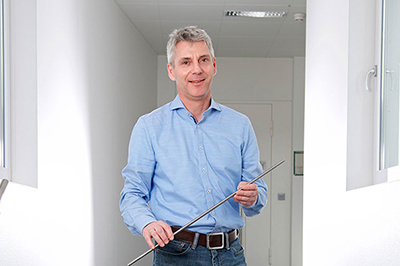
One of the broad research areas at PSI covers the topic of energy. Part of that, in turn, is the research for nuclear energy and safety. And one of the research groups based here is engaged with nuclear fuels. Johannes Bertsch is the head of this group and investigates the importance of so-called cladding tubes and their protective layers.

Johannes Bertsch could probably sketch the construction of a nuclear power plant blindfolded, especially when it comes to the core of the plant: How many fuel rods, made of what materials, are arranged in how many bundles. He has the numbers, dimensions, and facts in his head. He is the head of the Research Group for Nuclear Fuels at PSI, and his area of expertise are the sheaths of the fuel rods: the so-called cladding tubes.

The cladding tubes enclose the energy source of the power plant, the fissile uranium. In other words: The uranium is pressed into tablet-shaped ceramic pellets which are then stacked inside the cladding tubes. Typically four metres long, the cladding tubes have a diameter of one centimetre and a wall thickness of only 0.6 millimetres – so these are very long tubes, about as big around as a finger, with thin walls made of a special alloy. In the core of a nuclear power plant, there are typically several tens of thousands of them.

The cladding tubes are designed to withstand high temperatures and pressure during operation; they should not develop any cracks even after the removal of the spent fuel rods from the reactor, and they should survive transport undamaged – first to an interim storage facility and later to permanent storage. Therefore the cladding tubes aren’t made from just any sheet metal, but rather from a very finely balanced metal alloy: to 98% zirconium are added well thought-out amounts of chromium, iron, nickel, niobium, and tin. This special alloy is manufactured using a process just as special: melted, cooled in a controlled way, drawn, hammered and annealed. The result is a metal that, viewed microscopically, consists of tiny crystalline grains whose size is just as optimised as their internal crystalline orientation. There are decades of research and optimisation behind that, Bertsch says.

Today this optimisation process is mainly focused on one concern: Hydrogen should penetrate as little as possible into the metal of the cladding tubes, because there the hydrogen forms bonds with the metal atoms that could weaken the material of the cladding tubes.

The hydrogen itself comes from the water that – at least in the Swiss nuclear power plants – is essential. During operation, water continuously surrounds the fuel rods, cools them, and removes the heat arising from the fission of the atomic nuclei. This creates steam that drives the large turbines by which, ultimately, the nuclear power plant produces electricity.

So there’s no way to avoid the hydrogen. But what happens when the small atoms of hydrogen wangle their way into the atomic lattice of the metal alloy?

“Like sugar in coffee”

“First, the hydrogen is dissolved in it”, Bertsch says. Although these are single atoms in a solid material, the researchers talk about it as a solution. “It is actually like sugar in coffee”, Bertsch continues. And from the coffee, you know: If it’s too much sugar, or if the coffee is too cold, the sugar does not dissolve any more, and it accumulates on the bottom of the cup.

Here the analogy ends; there is no bottom of the cup. What actually happens: The hydrogen no longer moves freely through the material, but instead chemically bonds with the metal atoms to form a hydrogen-metal compound. A hydride, as the researchers call it.

The problem with these hydrides: “They form elongated, platelet-like, criss-crossing structures in the metal of the cladding tube. And these are weak points in the material.”

Imaging with neutrons makes hydrogen visible

The PSI researchers who work with Johannes Bertsch concern themselves with everything related to these hydrides. How do they alter the stability of the material? How can they be minimised? How can it be ensured that all cladding tubes stay intact at all times? “We are expanding the knowledge that exists in this context”, Bertsch says.

To do that, he and his colleagues rely on a method of imaging by means of neutrons. Neutron imaging, as it is called, is a method that was perfected at PSI and is regularly carried out by one of PSI’s own research groups at the local neutron source SINQ, with one of the world’s best neutron microscopes. With it, the most diverse types of objects can be examined.

Zirconium is virtually transparent for neutrons. That accounts for its use as the main component of the cladding tubes, since in the operation of a nuclear power plant, free neutrons are a desirable product. In addition, this proves to be an advantage in neutron imaging, because unlike zirconium, hydrogen reveals itself in neutron images as a dark contrast.

Protective layer may also help against hydrides

In one of their newest research projects, Bertsch’s research group is studying the additional protective layer on cladding tubes: So-called liners are used worldwide, and particularly in Switzerland. They protect the cladding tubes against mechanical damage and against oxidation.

Liners, Bertsch and his colleagues found, have a positive side-effect in eliminating hydrides: Cladding tubes equipped with such a protective layer exhibit less hydrides underneath. “The hydrogen penetrates more and more into this layer and already gets stopped there”, says Bertsch, summarising the research results. “You can say the liner is like a sponge for the hydrogen.” It’s as if a person in a bathrobe were to walk in drizzling rain: The terry cloth soaks up the water, and the skin stays dry.

Since it is already clear that hydrides weaken the cladding tubes mechanically, the researchers now venture the cautious statement that the liners, which were introduced originally for other reasons, probably make the cladding more stable in the long run.

“Ultimately, it’s our job to better understand how to make the operation and the handling of spent fuel rods even safer”, Bertsch says. “To do that, we investigate the details of the material’s internal structure. How the hydrides arise, how they are distributed, how they weaken the material – and above all, how they can be minimised.”

International interest

The comprehensive research on hydrides that Bertsch and his team are engaged with is first and foremost aimed at ensuring the safety of the nuclear facilities in Switzerland. But their work also meets with great interest internationally. “We get inquiries from Germany, where the reactors are now being shut down, and we have already been invited to the USA”, Bertsch relates. “Hydrides in cladding tubes are actually a hot topic in the research world.”

Источник: eurosafe-forum, November 2019
Теги: Bertsch, PSI

Material from PSI helps to check inconsistencies in the Big Bang theory

Shortly after the Big Bang, radioactive atoms of the type beryllium-7, among others, came into being. Today, throughout the universe, they have long since decayed and do not occur naturally, in contrast to their decay product lithium. Now researchers at the Paul Scherrer Institute PSI have helped to better understand the first minutes of the universe: They collected artificially produced beryllium-7 and made it into a sample that could be investigated. The beryllium-7 was subsequently probed by researchers at CERN. The joint study by PSI, CERN, and 41 other research institutions addresses the so-called cosmological lithium problem: There is a marked discrepancy between the amount of lithium the Big Bang theory predicts should be in the universe and the amount of lithium actually observed. According to the present study, it now appears more likely that the cause of this cosmological lithium problem lies in the theoretical description of the origin of the universe. The scientific community will thus have to keep searching for a solution to the cosmological lithium problem. The researchers now published their results in the journal Physical Review Letters.

Researchers at the Paul Scherrer Institute have provided a hard-won puzzle piece towards a better understanding of the universe’s origin: They were able to produce a sample of extremely rare and short-lived atoms of the isotope beryllium-7. Subsequently, at CERN, it was possible to probe this beryllium-7 – in practice, its interaction with neutrons – with far more precision than ever before.

Since through its radioactive decay beryllium-7 becomes lithium-7, studying it can help to crack a fundamental problem of the Big Bang theory: The theory predicts a three to four times greater amount of lithium in the universe than actual measurements show. This so-called cosmological lithium problem is one of the last great riddles of the current theory of the origin of the universe, because for all other elements produced shortly after the Big Bang, the theory conforms well to the measured data.

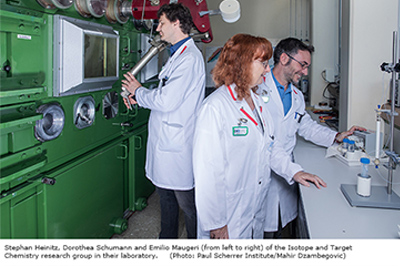
Emilio Maugeri, Stephan Heinitz and Dorothea Schumann (from left to right) of the Isotope and Target Chemistry research group. (Photo: Paul Scherrer Institute/Mahir Dzambegovic)Virtually all of the present-day lithium-7 in the universe comes from the decayed beryllium-7 which in turn was formed shortly after the big bang. Thus the researchers were looking into the question of whether there might have been less beryllium in the beginning than previously believed, which could clear up the cosmological lithium problem. One of the last possibilities still open to be checked was the so-called neutron capture cross-section of beryllium-7. This value predicts the probability that a beryllium-7 atomic nucleus will capture a free neutron and subsequently decay.

“The neutron capture cross-section of beryllium-7 was last measured, imprecisely by comparison, around 50 years ago”, explains PSI researcher Dorothea Schumann, head of the Isotope and Target Chemistry research group. This key figure should now be investigated at CERN, more accurately than ever before. The beryllium-7 sample needed for this was provided by the PSI researchers.

Years of preparation and test runs

The production and measurement of the beryllium-7 sample was like a one-time theatre performance, for which the researchers had to do around three years of preparatory work and test runs. Beryllium-7 disappears so rapidly through radioactive decay that its quantity is reduced by half roughly every 53 days. Therefore everything had to be in position before the actual run at both PSI and CERN, as well as for transportation between the two institutions – so that as little time as possible would elapse between the production of the sample and the measurement.

The idea for the experiment arose in 2012. PSI researcher Schumann knew that she could extract the rare beryllium-7 from the cooling water of the Swiss Spallation Neutron Source SINQ, which is operated at PSI for experiments with neutron beams.

“Here at PSI, with SINQ and the other large research facilities, we have unique sources for harvesting rare radioactive isotopes”, Schumann says. “For the researchers who operate and use these facilities, these isotopes are a by-product – but for many other research institutions, they are very useful and urgently needed”. Like gold prospectors, Schumann and her research group extract these rare isotopes. “And then we act as an interface to other researchers outside PSI who are interested in enriched samples of these isotopes.”

CERN is interested

Researchers at CERN showed interest in obtaining a sample of beryllium-7. “With it, they knew they could tackle the cosmological lithium problem”, Schumann explains.

So Schumann and her team set about the preparations: Within PSI, Schumann made contact with the scientists and engineers who operate SINQ. A special filter system meeting the isotope researchers’ specifications was connected to the cooling water of SINQ, which could collect material containing a suitable amount of beryllium-7 over a period of about three weeks. “To the layperson, our filter can be thought of as being quite similar to the familiar household filter for tap water”, says Stephan Heinitz, scientist in the research group of Schumann.

Then, among other things, the materials gathered in this way had to be chemically separated. “This requires special expertise – which luckily we have in my research group”, Schumann says. Nevertheless, this procedure took another week and had to be carried out, for protection against radiation from the material, in a so-called hot cell – a laboratory set up for the manipulation of radioactive materials.

A transport weight of 800 kilograms

From there, the concentrated sample of beryllium-7 had to be transferred into a suitable mount, and this in turn into an apparatus about the size of a cooking pot, which met specifications for use in the experimental setup at CERN. “The apparatus as well as the radiation-proof containers for transferring the material – all of it was custom-made”, relates Emilio Maugeri, another researcher in Schumann’s group.

Finally, arrangements had to be organised and approved to transport a heavy load of radioactive materials from PSI to CERN.

“The actual sample that we delivered to CERN contained only a few millionths of a gram of beryllium-7”, Schumann explains. “But the required shielding brought the transport weight up to 800 kilograms.”

Within the critical time period, everything succeeded according to plan. The CERN researchers were able to carry out the experiment with the PSI sample and determine the thus-far insufficiently known neutron capture cross-section of beryllium-7.

The cosmological lithium problem remains unsolved

The CERN and PSI scientists and their collaborators from 41 other research institutions were especially interested in a particular decay path of beryllium-7: the probability of a process by which an atomic nucleus of beryllium-7 traps a free neutron – that is, an elementary particle with no net charge. At the same time one of the protons leaves the beryllium nucleus. Thus, since the nucleus now contains one less proton (and one more neutron), the beryllium atom transforms itself into an atom of the element lithium: It becomes lithium-7. The so-called neutron capture cross-section – that is, the probability of this entire process – depends on the energy that the free neutron has. Therefore the researchers took advantage of the possibility at CERN to vary the energy of the neutrons, and they made a measurement series for a wide range of neutron energies.

Yet these latest measurements of the neutron capture cross-section have not solved the cosmological lithium problem. As Schumann puts it: “With the new measurements, the CERN researchers were able to determine the neutron capture cross-section so precisely that it now is clear: The cosmological lithium problem can’t be solved in this way; it still persists. The scientific community will have to keep looking for an explanation.”

Источник: eurosafe-forum, November 2019

Теги: CERN, PSI, test