
The Effect of Temperatures on the Criticality Safety of Fissile Systems
 Wood’s Regulatory Support Directorate carried out a study into the effect of temperature on the criticality safety of fissile systems for the Office for Nuclear Regulation (ONR), the UK civil nuclear regulator.
Criticality calculations for fissile material transport packages are typically carried out at room temperature. However, transport packages may encounter a wide range of temperatures, and the IAEA Transport Regulations state that packages shall be designed for ambient temperatures from ‑40°C to +38°C. Previous work on temperature effects has mainly looked at the high temperatures found in reactors, but this new study also considers temperatures below freezing.
Calculations were carried out using the Monte-Carlo criticality code MONK over a temperature range from 193 ‑ 1073K, (-80oC – 800oC) with 273K (0oC) being calculated for both water and ice. The interaction of thermal neutrons in water and in ice has been shown to be significantly different, even at similar temperatures. The crystalline structure that forms when water freezes not only leads to a reduction in density but a change to the nature of the interactions between the atomic bonds within a single H2O molecule and between adjacent molecules. Therefore, the bound thermal scattering data is fundamentally different between water and ice.
The report presents an investigation into the effect of temperature on the reactivity of fissile systems. An explanation of the important physical phenomena that may result in changes in the reactivity of a fissile system with temperature is provided. One of the main effects is the Doppler broadening of resonances in the neutron cross sections.
A range of calculations was performed to estimate how a change in temperature influences the neutron multiplication factor, K, in a number of fissile systems. The range of materials covered in the study included a number of fissile / fissionable species being one or more of U-235, U-238, Pu-239 and Pu-240 combined with different moderator materials (water/ice, polythene or graphite). The systems were modelled as either an infinite mixture or an infinite array of pin-cells, therefore the measure of neutron multiplication considered in all cases is Kinfinity (no leakage of neutrons from the system).
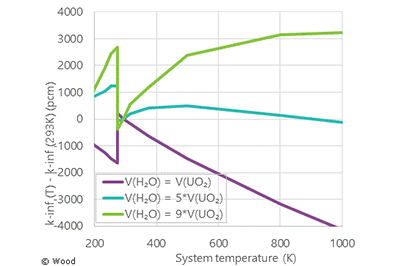
Results are plotted as difference in k against temperature and against moderator-to-fuel ratio. The example in the graph above is for 5% enriched uranium oxide rods in light water. The unit cell size was adjusted to give three different water volume to fuel volume ratios V(H20) to V(UO2).
The discontinuity at 273K (0°C) is clear. For an under-moderated system, reactivity decreases with increasing temperature; for an over-moderated system, reactivity increases with temperature.
The report compares the major criticality codes MONK, MCNP and SCALE-KENO with respect to their current and developing abilities to model the temperature dependence of neutron multiplication. This includes consideration of the limitations of the available nuclear data.
The study concluded that variation of reactivity with temperature is not always intuitive, and those assessing transport safety cases should be aware that for some systems criticality safety margins may be smallest at temperatures below freezing.
A full report on the findings is available on the ONR website here:
http://www.onr.org.uk/documents/2019/onr-rrr-077.pdf
Contact
Steve Power, Wood
steve.power@woodplc.com
Источник: eurosafe-forum 5.2019
 Екидин А. А., к.ф.-м.н. (