 When the UK Government published the draft European Union (Withdrawal) Bill on January 26, 2017, it became clear that Brexit would also mean Brexatom. To the surprise of some, the UK signalled its intention to withdraw from the European Atomic Energy Community (Euratom).
This was driven by a desire to leave the jurisdiction of the European Court of Justice and to end the free movement of people, both of which are enshrined in the Euratom treaty.
At the time of writing, the UK and EU’s efforts to reach a negotiated agreement remain frustrated by politics. But the nuclear landscape appears much more settled than anything else on the Brexit horizon.
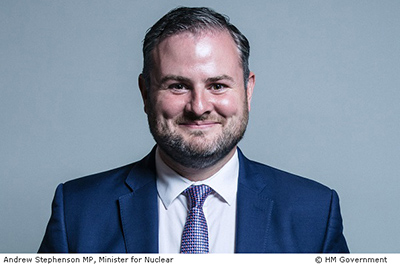
Andrew Stephenson, minister for nuclear, told the House of Commons in a written statement on May 15, 2019: “Government’s preparations for the UK’s withdrawal from Euratom mean that the UK now has all the necessary measures in place to ensure that the UK nuclear industry can continue to operate with certainty in all situations.”1
To replace Euratom, the UK government has sought to create alternative arrangements to avoid any lapse in the ability to conduct international nuclear trade if it can no longer rely on Euratom’s nuclear co-operation agreements (NCAs) in a post-Brexit world.
The first task was to take back control of the nuclear safeguarding system, which must demonstrate that civil nuclear materials are not being diverted into military or weapons programmes.
During its membership of Euratom, UK safeguarding measures have been implemented by the European Commission, which also conveys relevant information to the International Atomic Energy Agency in compliance with international standards.
The UK has passed the Nuclear Safeguards Act giving the Office for Nuclear Regulation (ONR) domestic oversight post Brexit. It has also signed two new bilateral agreements on safeguarding with the IAEA, a voluntary offer agreement and an additional protocol.
The legal framework for ONR oversight was codified quickly. Public consultation on the draft Nuclear Safeguards Regulations, which set out the new domestic civil nuclear safeguards regime, closed in September 2018 and the UK Parliament debated and approved the regulations in January 2019.
The ONR met its target for recruiting additional inspectors ahead of the original departure date of 29 March and the delay in reaching a Brexit agreement can only assist in ensuring that the new inspectorate is up and running when Brexatom finally arrives.
The Safeguards Information Management and Reporting System is now running parallel with Euratom to ensure a seamless transition when the time comes and the UK government has committed to meeting in full the set-up costs of the new ONR safeguarding regime.
There is widespread confidence that the new regime will be as thorough and effective as that overseen by Euratom.
The UK’s international nuclear trade will also be protected by newly agreed NCAs with the US, Australia, Canada and Japan which will take effect when the UK leaves the EU and on terms equivalent to the existing Euratom arrangements.
On top of this, the UK government says discussions are going well with Japan on the continuation of a bilateral nuclear trade arrangement which has been in place since 1998.
Despite leaving Euratom, the UK wants to maintain a close association so that mutually successful civil nuclear cooperation is maintained. There are hopes for an enhanced NCA to formalise cooperation between ONR and the European Commission on safeguards, participation in the Euratom Research and Training Programme, contractual arrangements for the supply of nuclear materials, and to minimise trade barriers. Agreement in principle has already been reached on safeguarding mechanisms and the UK’s continued involvement in the Joint European Torus.
If there is no exit deal, the UK still risks losing influence in nuclear cooperation across Europe. And although Britain’s nuclear sector and the Euratom community are equally keen to ensure business as usual, a lot will depend on whether the tangled politics of the withdrawal agreement can be resolved.
Contact
David Boath, Wood
david.boath@woodplc.com
1 Andrew Stephenson’s parliamentary statement, with links to relevant new legislation and further guidance, can be found here.
Источник: eurosafe-forum 5.2019

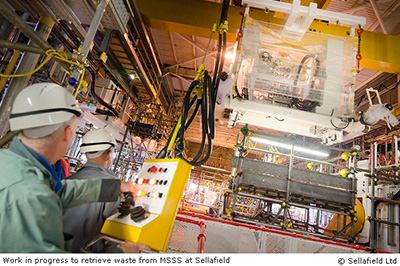 Waste retrieved from the Magnox Swarf Storage Silo (MSSS) at Sellafield is being safely stored in an unencapsulated form for 50-75 years. This has never been done before and it is safety critical that hydrogen generation is measured and managed, especially when the waste first goes into store.