Метка: UK

Sealing the deal

Pipework for the shield cooling system at the Palisades nuclear power plant in Covert, Michigan, is buried in concrete.

This means it shares a problem with the UK’s advanced gas-cooled reactors, which have the same design feature. When cooling pipes develop tiny cracks and begin to leak, access is impossible for conventional repair methods such as welding.

That’s why engineers from Wood have been called out three times to Palisades over the past 29 years to apply their own method of sealing the pipes.

The latest visit was part of $87m of work carried out by plant owner and operator Entergy during a two-month refuelling outage which ended on December 28, 2018.

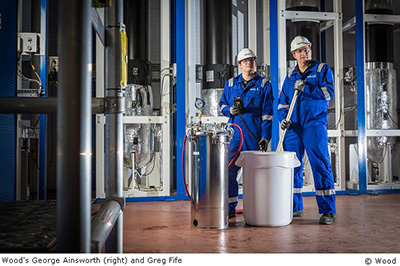
George Ainsworth, a metallurgist who led the Wood team, describes how the leak sealing process works: “We inject a proprietary sealing formulation, consisting of resin and clay, into the pipe run, then pressurise it up to 40 pounds per square inch so that the mixture is forced into any defects responsible for the leakage. Then we flush out the excess, leaving plugs in the defects.

“This sounds very simple, but in reality every defect is different and we have to assess the pipe materials and geometry, the operating environment and the defect size to determine the best sealant formulation and application to use.

“Cracks also develop for different reasons, such as thermal expansion and contraction, stress or corrosion.”

At Palisades, George and colleagues Greg Fife and Joseph Large finished five days ahead of schedule by working simultaneously on most of the eight pipework systems which required attention. And they received a 10-out-of-10 score on every single customer feedback question.

Developed in the 1960s to repair pressure vessel cooling water pipes in the UK, Wood’s leak sealing service has been successfully used worldwide in nuclear power plants, research facilities, nuclear fusion experiments, processing plants, chemical plants, particle accelerators, heat exchangers, water treatment plants and nickel refineries.

Since then, it has been continually developed and improved from the initial concept so that there are now many variations and formulas to deal with a wide range of scenarios. As well as sealing pipes buried in concrete, the technology can be used wherever it is physically impossible to gain access or dangerous to do so because of hazards such as radioactivity, or where the cost of dismantling complex systems is too high.

Even so, Wood’s team is unlikely to return to Palisades because the 811 MW plant is scheduled for permanent retirement in the spring of 2022, 51 years after it first began generating electricity.


Facts about Wood’s leak sealing service

  • Seals holes up to 10 millimetres effective diameter
  • Highly durable and withstands operating pressures of up to 1,000 pounds per square inch
  • Resists corrosive or radioactive environments
  • Does not adversely affect pipework
  • Tackles pipe runs up to 100 cubic metres in volume
  • Successful in a range of operating environments, including highly concentrated nitric acid
  • Treats carbon steel, copper, stainless steel and other materials
  • Post-treatment flushing ensures that all excess material is removed, eliminating the risk of plugging the pipework
  • Performed by fully qualified and experienced teams
  • Unintrusive, requires minimal plant modification
  • In the unlikely event that the repair is unsuccessful, the process can be repeated
  • In collaboration with Wood’s remote operations team, bespoke delivery systems can be developed for localised treatments


Contact
George Ainsworth, Wood
george.ainsworth@woodplc.com

Источник: eurosafe-forum 5.2019
Making a success of Brexatom

When the UK Government published the draft European Union (Withdrawal) Bill on January 26, 2017, it became clear that Brexit would also mean Brexatom. To the surprise of some, the UK signalled its intention to withdraw from the European Atomic Energy Community (Euratom).

This was driven by a desire to leave the jurisdiction of the European Court of Justice and to end the free movement of people, both of which are enshrined in the Euratom treaty.

At the time of writing, the UK and EU’s efforts to reach a negotiated agreement remain frustrated by politics. But the nuclear landscape appears much more settled than anything else on the Brexit horizon.

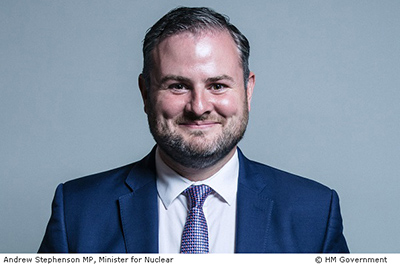
Andrew Stephenson, minister for nuclear, told the House of Commons in a written statement on May 15, 2019: “Government’s preparations for the UK’s withdrawal from Euratom mean that the UK now has all the necessary measures in place to ensure that the UK nuclear industry can continue to operate with certainty in all situations.”1

To replace Euratom, the UK government has sought to create alternative arrangements to avoid any lapse in the ability to conduct international nuclear trade if it can no longer rely on Euratom’s nuclear co-operation agreements (NCAs) in a post-Brexit world.

The first task was to take back control of the nuclear safeguarding system, which must demonstrate that civil nuclear materials are not being diverted into military or weapons programmes.

During its membership of Euratom, UK safeguarding measures have been implemented by the European Commission, which also conveys relevant information to the International Atomic Energy Agency in compliance with international standards.

The UK has passed the Nuclear Safeguards Act giving the Office for Nuclear Regulation (ONR) domestic oversight post Brexit. It has also signed two new bilateral agreements on safeguarding with the IAEA, a voluntary offer agreement and an additional protocol.

The legal framework for ONR oversight was codified quickly. Public consultation on the draft Nuclear Safeguards Regulations, which set out the new domestic civil nuclear safeguards regime, closed in September 2018 and the UK Parliament debated and approved the regulations in January 2019.

The ONR met its target for recruiting additional inspectors ahead of the original departure date of 29 March and the delay in reaching a Brexit agreement can only assist in ensuring that the new inspectorate is up and running when Brexatom finally arrives.

The Safeguards Information Management and Reporting System is now running parallel with Euratom to ensure a seamless transition when the time comes and the UK government has committed to meeting in full the set-up costs of the new ONR safeguarding regime.

There is widespread confidence that the new regime will be as thorough and effective as that overseen by Euratom.

The UK’s international nuclear trade will also be protected by newly agreed NCAs with the US, Australia, Canada and Japan which will take effect when the UK leaves the EU and on terms equivalent to the existing Euratom arrangements.

On top of this, the UK government says discussions are going well with Japan on the continuation of a bilateral nuclear trade arrangement which has been in place since 1998.

Despite leaving Euratom, the UK wants to maintain a close association so that mutually successful civil nuclear cooperation is maintained. There are hopes for an enhanced NCA to formalise cooperation between ONR and the European Commission on safeguards, participation in the Euratom Research and Training Programme, contractual arrangements for the supply of nuclear materials, and to minimise trade barriers. Agreement in principle has already been reached on safeguarding mechanisms and the UK’s continued involvement in the Joint European Torus.

If there is no exit deal, the UK still risks losing influence in nuclear cooperation across Europe. And although Britain’s nuclear sector and the Euratom community are equally keen to ensure business as usual, a lot will depend on whether the tangled politics of the withdrawal agreement can be resolved.


Contact
David Boath, Wood
david.boath@woodplc.com

1 Andrew Stephenson’s parliamentary statement, with links to relevant new legislation and further guidance, can be found here.

Источник: eurosafe-forum 5.2019

Bespoke glovebox project supports transatlantic transfer of nuclear material

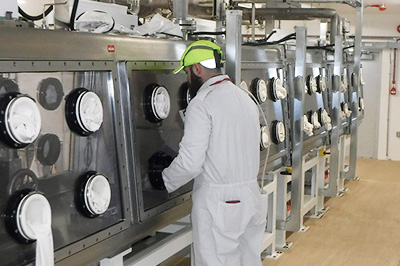
Wood designed, built and commissioned equipment and facilities used to repackage nuclear material so that it could be transported across the Atlantic.

The UK’s Nuclear Decommissioning Authority (NDA) and the USA’s National Nuclear Security Administration (NNSA) recently announced the successful completion of the export programme.

A suite of bespoke gloveboxes was built within a purpose-built, seismically qualified structure inside an existing facility, so that the highly enriched uranium (HEU) could be handled safely within a controlled environment at the Dounreay nuclear site in Scotland, UK.

Working with the team at site operators Dounreay Site Restoration Ltd, Wood was responsible for all aspects of the engineering including process, civil, HVAC and control and instrumentation design. The company’s criticality and shielding team carried out hundreds of software calculations to demonstrate process safety covering both radiation protection and criticality.

Andy White, vice president (decommissioning) at Wood, said: “Wood and its partners in the UK’s nuclear supply chain rose to this technically demanding challenge and we are proud to see that the programme has reached a successful conclusion.”

Manufacturing of the gloveboxes was supported by Wood’s partners: Caithness-based Gow’s Lybster Ltd, Hampshire-based Aquila Nuclear Engineering and Oldham-based Universal Fabrications (North West) Ltd.

The completed transfer of around 700kg of HEU from Dounreay, in the north of Scotland, to the US was announced by the NDA and NNSA on May 3, 2019.

The HEU transfer was part of the UK Government’s commitment to the 2016 Nuclear Security Summit held in Washington DC.

NDA CEO, David Peattie, thanked the staff from Dounreay Site Restoration Limited, counterparts from the US Department of Energy and the other agencies involved with coordinating the movement of the material, for their commitment and hard work.

David Peattie said: “The successful completion of the complex work to transfer HEU is an important milestone in the programme to decommission and clean up Dounreay Site.”

The HEU will be down-blended in the US to be used as fuel in civil nuclear reactors – for entirely peaceful purposes.

The US is sending a different form of the material to Europe, where it will be used as research reactor fuel and in the production of medical isotopes.

Lisa E. Gordon-Hagerty, US Department of Energy Under Secretary for Nuclear Security and NNSA Administrator, added: “This joint effort highlights our strong cooperation and mutual non-proliferation goals.”

The removal is an element of a worldwide effort to increase nuclear security by reducing HEU inventories. It also is part of a 2014 agreement between DOE/NNSA and the Euratom Supply Agency to reduce HEU while supporting medical isotope production and research reactors in Europe.

Contact
Matthew Smith, Wood
matthew.smith@woodplc.com

Источник: eurosafe-forum 5.2019